Throughout the summer, I've been indulging my love of reading, which in my adult life has come to mean more nonfiction works in the form of things by Michael Pollan (such as The Botany of Desire and The Omnivore's Dilemma) and other similar works on simple living (of course these were borrowed or from the library, so my reading habit hasn't eaten up any of our budget this summer). Among the things I've been reading about this summer, greywater (water that has been used for laundry, dishes, etc. and could potentially be reused to irrigate the gardens) has been a topic, one which very much intrigues me.
One day we'd love to install a greywater laundry system, since we already use phosphate free laundry detergent (Charlie's Soap or Seventh Generation) and our homemade lavender laundry booster. However, the current NC building code doesn't make this the simplest thing to do in a residential setting, and our budget for household projects wouldn't accommodate it anyway since we're replacing the roof and covering the front deck with a metal roof. So, in the interim (or perhaps forever, depending on how the code and our budget go), we're implementing some simple greywater solutions.
1. All leftover water and icecubes in drinking glasses at the end of the day go to water indoor or outdoor plants. This means that I don't have to remember to water the houseplants once or twice a week and these small amounts of potable water don't go to waste by simply pouring them down the drain. (It's taken a while to train the family, but they've got the hang of it now.) The icecubes are great because they provide a slow gradual water source over an hour or so. We really try to drink only water in our house, though we sometimes succumb to the "need" for sweet tea or juice in the summer, or hot tea/coffee in the winter or mornings. This makes things easy and we don't have to worry about giving the plants something that might not be healthy for them. (Black coffee or unsweetened tea is fine for plants, especially blueberries which love acidic soils, so we sometimes pour leftovers of these on the blueberry plants--when I remember.)
2. Water from boiling pasta, corn on the cob, seafood, or canning is caught and cooled. Then, I take it outside to water the veggie garden or flower garden. If it's salted water, then I am more selective about where I put it (it might go on the weeds growing in the gravel driveway to kill them, rather than killing my flowers or stressing the veggies).
3. Water from washing dishes by hand is caught in a pot/bowl rather than the sink and poured over outdoor plants. The small amount of soap helps to deter pests and any organic matter (bits of lettuce, pasta, etc.) just decomposes in the soil. We try to use phosphate-free soaps here too, so they don't contaminate the groundwater. (This is key for us, since our water comes from a shared well and not a municipal source.)
All in all, I figure these actions lessen our need for irrigation considerably. I've really tried to subscribe to the xeriscaping philosophy with my flower gardens and only water the veggie garden on a regular basis. The flower gardens are watered with all this greywater I've described above. I can't imagine what else I could grow if we had the laundry greywater system in place!
So, what about you... what're you doing to capture greywater or conserve water on a regular basis? Have you experimented with a greywater system, or is yours just hodge podge like ours? I'd love to hear from you!

Showing posts with label seventh generation. Show all posts
Showing posts with label seventh generation. Show all posts
Wednesday, August 3, 2011

Wednesday, February 24, 2010
Green Groceries on a Budget
So, I realized that I forgot to fill you in on our awesome grocery adventure this past Saturday.
As I've mentioned before, we use the Grocery Game, which helps us tremendously in matching up sales and coupons. This allows us to save the most, while still getting the products we need. The Grocery Game tracks the store sales, which are typically cyclical (they run in trends of about 8-12 weeks), so we have to stockpile a little in order to have what we need when we need it and save the most.
This past weekend was Super Double Coupons at Harris Teeter, so that means that they doubled coupons up to $1.98, not just their general doubling of $0.99 coupons. So, we hauled our our coupons that were over 99 cents and looked at the list and laid out our plans for the trip. We mostly bought things that were on the list, but there were a few things, like pistachios (they've been a great healthy snack this week) and Seventh Generation products (like toilet paper) that we had coupons for that we printed off the internet or had from other sources that weren't in the list. So, we used those too, knowing that we'd still get a pretty good savings. The extra savings we had from super doubled coupons allowed us to purchase the organic products that we wanted for the week, like milk and some organic produce.
Speaking of organic, here's my basic philosophy on organic produce... it's worth buying organic when you can for the veggies/fruits you're not going to peel. So, I'll spring for organic cabbage, peppers, tomatoes, berries (but not once we have our raspberries and blueberries planted), etc. because they're most likely to have herbicide/pesticide residues on them that won't wash off completely. However, I don't buy organic citrus fruits, onions, bananas, etc. because the area that has the most of these chemicals is coming off anyway. With milk, I try to buy organic because I don't like the idea of all the hormones that the cows are fed/injected with leeching into my milk.
So, back to the savings. Because of the Grocery Game list, we were able to get five boxes of whole grain pasta for 60 cents each. (All the pastas of that brand were on sale, buy two get three free, but we opted for the whole grain--which we finally found way down on the bottom shelf.) We also bought a TON of yogurt (Yoplait--not organic, bummer on that, but it's really good) because with our coupons that we'd stocked up on, it was 37 cents a carton, over half of the original price. We were missing a few coupons on the list, because we'd missed getting a paper that week (by the way, the cheapest Sunday paper in Boone is at the Dollar Tree, but they go fast, so we get ours before church if we can), so we missed out on a few good freebies. We were able to score some Seventh Generation baby wipes for about half the original price with our online coupon.
All in all, even with our organic purchases and produce that wasn't on the GG list, we were able to save over $60 and spent around $58. A little over 50% savings wasn't too bad, I don't think... although there have been weeks we've seen a 70% savings.
So, what about you? What are your great savings stories? Where do you find the best deals? Please dish... you know how we love a great deal!
Sharin' the green love and savings!
As I've mentioned before, we use the Grocery Game, which helps us tremendously in matching up sales and coupons. This allows us to save the most, while still getting the products we need. The Grocery Game tracks the store sales, which are typically cyclical (they run in trends of about 8-12 weeks), so we have to stockpile a little in order to have what we need when we need it and save the most.
This past weekend was Super Double Coupons at Harris Teeter, so that means that they doubled coupons up to $1.98, not just their general doubling of $0.99 coupons. So, we hauled our our coupons that were over 99 cents and looked at the list and laid out our plans for the trip. We mostly bought things that were on the list, but there were a few things, like pistachios (they've been a great healthy snack this week) and Seventh Generation products (like toilet paper) that we had coupons for that we printed off the internet or had from other sources that weren't in the list. So, we used those too, knowing that we'd still get a pretty good savings. The extra savings we had from super doubled coupons allowed us to purchase the organic products that we wanted for the week, like milk and some organic produce.
Speaking of organic, here's my basic philosophy on organic produce... it's worth buying organic when you can for the veggies/fruits you're not going to peel. So, I'll spring for organic cabbage, peppers, tomatoes, berries (but not once we have our raspberries and blueberries planted), etc. because they're most likely to have herbicide/pesticide residues on them that won't wash off completely. However, I don't buy organic citrus fruits, onions, bananas, etc. because the area that has the most of these chemicals is coming off anyway. With milk, I try to buy organic because I don't like the idea of all the hormones that the cows are fed/injected with leeching into my milk.
So, back to the savings. Because of the Grocery Game list, we were able to get five boxes of whole grain pasta for 60 cents each. (All the pastas of that brand were on sale, buy two get three free, but we opted for the whole grain--which we finally found way down on the bottom shelf.) We also bought a TON of yogurt (Yoplait--not organic, bummer on that, but it's really good) because with our coupons that we'd stocked up on, it was 37 cents a carton, over half of the original price. We were missing a few coupons on the list, because we'd missed getting a paper that week (by the way, the cheapest Sunday paper in Boone is at the Dollar Tree, but they go fast, so we get ours before church if we can), so we missed out on a few good freebies. We were able to score some Seventh Generation baby wipes for about half the original price with our online coupon.
All in all, even with our organic purchases and produce that wasn't on the GG list, we were able to save over $60 and spent around $58. A little over 50% savings wasn't too bad, I don't think... although there have been weeks we've seen a 70% savings.
So, what about you? What are your great savings stories? Where do you find the best deals? Please dish... you know how we love a great deal!
Sharin' the green love and savings!
Friday, February 19, 2010
Green Paper Products
So, today's post is all about the ins and outs of green paper products, and how to reduce your consumption of paper products. 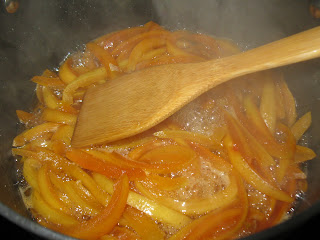 (As an aside, check out the candied grapefruit peel in progress... isn't it a beautiful color?)
We're currently in the transition in our home from standard paper products to recycled, in some cases. However, before we began thinking about this, we tried to reduce our comsumption of paper products as much as possible. Here's how:
1) We always use fabric napkins. They don't get ironed (unless we're having fancy company) and we try to use the same one for several meals. Since we always sit at the same place at the table (or on the couch if it's a movie night), it's easy to keep track of which napkin is Benny's and which is mine. We have several sets, some even handmade by Mom or old ones from my grandmother's house, so we're not ever without and they get thrown in the laundry with the towels.
2) As I mentioned in the cleaning post, we use rags and newspaper for almost all of our cleaning. This means that we don't have to use paper towels much (I think a roll of paper towels has been known to last us three months or more.) Using the newspaper also means that we can compost or recycle it, as long as we use natural and biodegradable cleaners. (Again, the rags go in the laundry with the towels or in a load with the dog blankets.)
3) We use paper plates/cups and plastic utensils as infrequently as possible, opting for compostable corn starch products or 100% recycled paper for parties. We use our standard dishes, even if we're having a dinner party with several couples invited. All of our standard stuff can go in the dishwasher, but we do handwash wine glasses and pottery stuff, because I just feel better about the glazing holding up, etc. Many of our dishes were gifts, so the cost of those didn't come out of our pocket. I did find these cool tumblers in the antique store in downtown Boone for $3 a piece. (Mom went halfs with me on them for a set of four.)
4) We reuse plastic grocery bags in our smaller trashcans around the house. (I think most people do this now.) I'm also working on crocheting a reusable bag out of cut up plastic grocery bags. Here's a pic of my "plarn" roll in the making. (It's still in the planning stages and is something Mom and I will tackle together over her spring break--we now have school, so I'll still be teaching during the day.) Benny found a new use for them while touching up paint... he lined the roller try with two. It didn't work quite as well as the plastic tray liners, but I think it probably used less plastic overall.
5) I take a lunch box to work, rather than a paper bag. (Again, I think most folks do this.) It means that I'm not paying for a school lunch (which is pricey for teachers and not all that nutritious) and I also take my own utensils and will begin taking my own cloth napkin, now that I have a few that are smaller lunch size ones.
6) We started, about two years ago, taking our own bags to the grocery store. Since I have accumulated so many from text book companies and conferences, we now have a set for each car. They're actually easier in the long run, once you get into the habit of getting them out of the backseat or trunk, because it means schlepping fewer bags from the car to the house when we get home. At some stores (unfortunately none in Boone, that I know of), you can even get a small credit for bringing your own bags.
7) I try to purchase recycled content aluminum foil when I need it, and when I use it, I'm sparing. The exciting news here is that some of the big name brands, like Reynold's, are coming up with recycled content products. So, that means coupons! So, not only are we saving the landfill space by using recycled content stuff, but the coupons allow us to purchase it for pennies on the dollar. (I think I paid 25 cents for the last roll of aluminum foil I bought.) Also, if you're careful, you can keep the foil clean and then recycle it, if not reuse it.
We're working on making the transition to recycled paper toilet paper. We still have some of the Scott Extra Soft left, so we'll use that up and then buy the recycled paper. We found that the Seventh Generation stuff has a pretty high recycled content, higher than the Scott Naturals, and the price is pretty comparable. When the Seventh Generation stuff goes on sale, we'll stock up and put some in the basement for when we need it. Seventh Generation is one of the leaders in green products and has tons of products available.
In terms of tissues, I haven't found a recycled content one that I like yet, so if you have any suggestions, let me know. Benny carries a handkerchief every day, so he uses that when he needs to, but I can't figure out how to carry one with as small as most women's pants pockets are. (If I'm sick, the handkie rubs my nose raw more than the tissues, so I generally opt for tissues.)
I've heard about corn starch kitchen trashbags, but haven't seen any on the market in Boone (although I haven't checked out EarthFare.) To fit our budget, we'll use up what we have of the standard ones before purchasing the corn starch ones. (I do feel a little better knowing that we're reducing our over trash as much as we can, so we're not putting as many plastic bags into the landfill as many families.)
If you've got any great green paper product ideas, please post them here! I'd love to know what you're doing and it'd be great to share those ideas with others. Sharin' the green love and savings!
 (As an aside, check out the candied grapefruit peel in progress... isn't it a beautiful color?)
We're currently in the transition in our home from standard paper products to recycled, in some cases. However, before we began thinking about this, we tried to reduce our comsumption of paper products as much as possible. Here's how:
1) We always use fabric napkins. They don't get ironed (unless we're having fancy company) and we try to use the same one for several meals. Since we always sit at the same place at the table (or on the couch if it's a movie night), it's easy to keep track of which napkin is Benny's and which is mine. We have several sets, some even handmade by Mom or old ones from my grandmother's house, so we're not ever without and they get thrown in the laundry with the towels.
2) As I mentioned in the cleaning post, we use rags and newspaper for almost all of our cleaning. This means that we don't have to use paper towels much (I think a roll of paper towels has been known to last us three months or more.) Using the newspaper also means that we can compost or recycle it, as long as we use natural and biodegradable cleaners. (Again, the rags go in the laundry with the towels or in a load with the dog blankets.)
3) We use paper plates/cups and plastic utensils as infrequently as possible, opting for compostable corn starch products or 100% recycled paper for parties. We use our standard dishes, even if we're having a dinner party with several couples invited.
 All of our standard stuff can go in the dishwasher, but we do handwash wine glasses and pottery stuff, because I just feel better about the glazing holding up, etc. Many of our dishes were gifts, so the cost of those didn't come out of our pocket. I did find these cool tumblers in the antique store in downtown Boone for $3 a piece. (Mom went halfs with me on them for a set of four.)
 4) We reuse plastic grocery bags in our smaller trashcans around the house. (I think most people do this now.) I'm also working on crocheting a reusable bag out of cut up plastic grocery bags. Here's a pic of my "plarn" roll in the making. (It's still in the planning stages and is something Mom and I will tackle together over her spring break--we now have school, so I'll still be teaching during the day.) Benny found a new use for them while touching up paint... he lined the roller try with two. It didn't work quite as well as the plastic tray liners, but I think it probably used less plastic overall.

5) I take a lunch box to work, rather than a paper bag. (Again, I think most folks do this.) It means that I'm not paying for a school lunch (which is pricey for teachers and not all that nutritious) and I also take my own utensils and will begin taking my own cloth napkin, now that I have a few that are smaller lunch size ones.
6) We started, about two years ago, taking our own bags to the grocery store. Since I have accumulated so many from text book companies and conferences, we now have a set for each car. They're actually easier in the long run, once you get into the habit of getting them out of the backseat or trunk, because it means schlepping fewer bags from the car to the house when we get home. At some stores (unfortunately none in Boone, that I know of), you can even get a small credit for bringing your own bags.
7) I try to purchase recycled content aluminum foil when I need it, and when I use it, I'm sparing. The exciting news here is that some of the big name brands, like Reynold's, are coming up with recycled content products. So, that means coupons! So, not only are we saving the landfill space by using recycled content stuff, but the coupons allow us to purchase it for pennies on the dollar. (I think I paid 25 cents for the last roll of aluminum foil I bought.) Also, if you're careful, you can keep the foil clean and then recycle it, if not reuse it.
We're working on making the transition to recycled paper toilet paper. We still have some of the Scott Extra Soft left, so we'll use that up and then buy the recycled paper. We found that the Seventh Generation stuff has a pretty high recycled content, higher than the Scott Naturals, and the price is pretty comparable. When the Seventh Generation stuff goes on sale, we'll stock up and put some in the basement for when we need it. Seventh Generation is one of the leaders in green products and has tons of products available.
In terms of tissues, I haven't found a recycled content one that I like yet, so if you have any suggestions, let me know. Benny carries a handkerchief every day, so he uses that when he needs to, but I can't figure out how to carry one with as small as most women's pants pockets are. (If I'm sick, the handkie rubs my nose raw more than the tissues, so I generally opt for tissues.)
I've heard about corn starch kitchen trashbags, but haven't seen any on the market in Boone (although I haven't checked out EarthFare.) To fit our budget, we'll use up what we have of the standard ones before purchasing the corn starch ones. (I do feel a little better knowing that we're reducing our over trash as much as we can, so we're not putting as many plastic bags into the landfill as many families.)
If you've got any great green paper product ideas, please post them here! I'd love to know what you're doing and it'd be great to share those ideas with others. Sharin' the green love and savings!
Subscribe to:
Posts (Atom)